
Breakfast with Lucretius
A glimpse into the greatest poem in the Latin language

Recently I completed my project of reading the whole of Lucretius’s De rerum natura (“On the Nature of Things”) in the original Latin. It is long: my rough estimate is that it is around 7,000 lines. (Lucretius’s dates are c.99 BC–c.55 BC.)
It was a pleasant experience. I usually read somewhere between 50 and 100 lines during breakfast. (No, I am not going to write a book called Breakfast with Lucretius.) I used Cyril Bailey’s edition with translation and annotations, although I bought a more recent Teubner edition from 2019 to see what the latest thoughts were about the text.
Because the text of Lucretius isn’t in good shape. The earliest manuscripts date from the eighth or ninth centuries. They are traced back to an original made in France around the fourth century. (Textual criticism of ancient works is an enormously subtle, complex, and fascinating matter.) One passage from the first book looks like this (see photo):
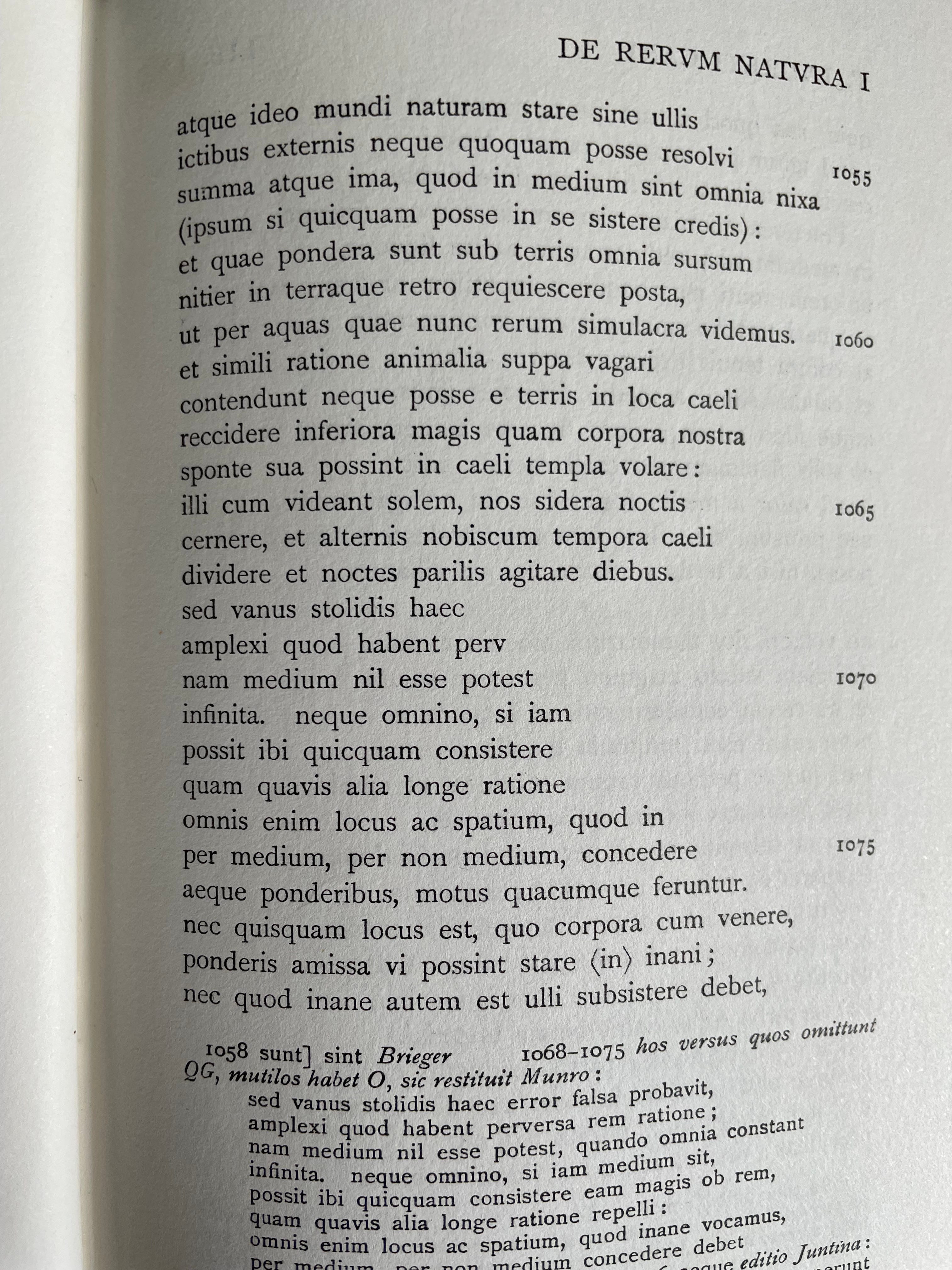
You don’t have to know Latin to see that these lines are incomplete. Why? Because the manuscripts are all copied from a single original, which had a corner torn off or eaten by a mouse or something. (Editors have made various efforts to fill in the missing text of the lines.)
To me this is a startling example of the tenuousness of our connection with classical antiquity.
Lucretius is a materialist. He is expounding the atomic theory of Epicurus. Nothing exists, he says, except atoms and the void. All objects are derived from the collisions and unions of these objects, which have greater or lesser affinity with one another depending on their shape and density. As such, nothing is permanent. A famous line says, “Nec minus ante haec quam tu cecidere, cadentque”: “No less than you these things that were before have fallen, and are falling.”
This line points to a central objective of Lucretius’s poem: to overcome the fear of death. He contrasts the vision of Epicurus with that of Greco-Roman religion, which posited a kind of hell that is i the direct progenitor of the Christian hell. Lucretius believes that this fear of hell is one of the greatest impediments to a rational human life. From the epic cycle he cites the example of Agamemnon, who sacrificed his daughter Iphigenia to Artemis in order to lift winds that were preventing his fleet from sailing to sack Troy.
A famous line from this passage: “Tantum religio potuit suadere malorum”: “Such were the evils religions could induce.”
Lucretius would not be happy to see how many people 2,000 years later live in dread of hell.
Epicurus’s view is materialistic. Both the soul and the body are composed of atoms that disunite at death, leaving nothing behind. You will be gone, but you won’t be around to miss it. Not everyone finds this consoling, but Lucretius did.
Some of you may remember that early on in my Substack history, I posted my translation of part of the first book of Lucretius. I did it back in 2003, then abandoned it for other projects. (It is still up.)
The English scholar D.R. Shackleton Bailey (a professor of mine at Harvard) remarked that De rerum natura is the greatest poem in the Latin language. I agree.
Copyright © 2026 by Richard Smoley.
I would like to read it. I first learned of it when researching for my book, "Francis Bacon's Hidden Hand in Shakespeare's 'The Merchant of Venice'" (pp. 36, 38-40). Bacon wrote of "De rerum natura" in his Novum Organum. In Robert Leslie Ellis's translation: "Again, discoveries are as it were new creations, and imitations of God's works; as well sang the poet: 'To man's frail race great Athens long ago, first gave the seed whence waving harvests grow, and recreated all our life below.' ('Aphorisms Concerning the Interpretation of Nature and the Kingdom of Man,' #129, Novum Organum, transl. Robert Leslie Ellis, "Works of Francis Bacon," ed. James Spedding (London: Longmans, 1857-74) 4:113-14. Bacon said the rule that the nature of everything is best seen in its smallest portions is "a rule of physics of such force that it produced the atoms of Democritus." (De Augmentis, bk 3, ch 1, Spedding 4:338). "For the microscope ..., is only available for minute objects; so that if Democritus had seen one, he would perhaps have leaped for joy, thinking a way was now discovered of discerning the atom, which he had declared to be altogether invisible." (Novum Organum, #39, Spedding 4:193).